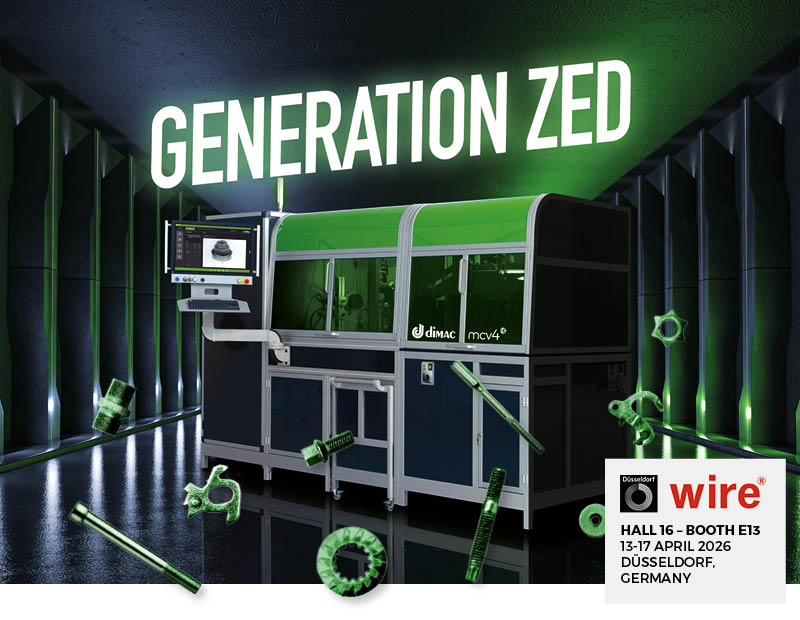
Dimac mcvZED @Wire 2026: the evolution of sorting machines driven by Artificial Intelligence, advanced UX and a Zero-Defect vision
At Wire 2026, Dimac officially introduces mcv ZED (as “ZED” stands for Zero Defect), the fourth generation of its sorting machines for fasteners and metal components.
Dimac mcv ZED machines natively integrate artificial intelligence to meet the needs of increasingly important sectors such as aerospace and electrical connectors/battery electronics.
Remaining true to its philosophy of quality, reliability, and technological continuity, Dimac has focused the development of mcv ZED on an enhancement of the user experience, adopting state-of-the-art technologies and renewing several aspects while preserving their proven strengths.
Innovative design, proven mechanical reliability
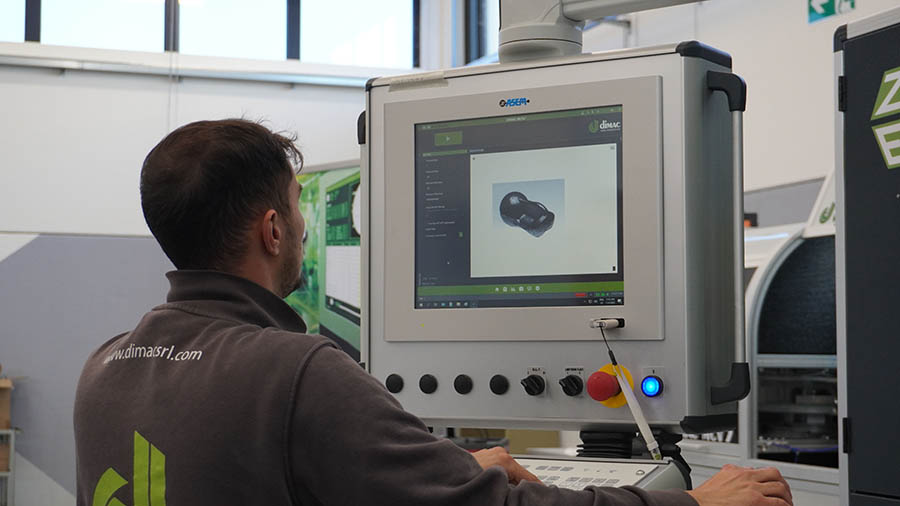
The new generation stands out immediately thanks to the monitor mounted on an articulated arm, featuring the patented sliding-arm solution, which redefines operator ergonomics.
A completely redesigned electronic and software core
The most profound evolution of mcv ZED lies in the electronic and software core of the machine.
Dimac has redesigned the entire architecture starting from two fundamental pillars: ease of use of the operator interface and long-term reliability in sorting accuracy.
The result is a platform that expands flexibility and reconfigurability and improves performance and efficiency. The underlying vision is a Zero-Defect factory, where all quality control equipment, from 100% sorting to SPC, interacts with each other and with production.
The goal is to reject defective parts but also to learn how to prevent defects from being generated.
Making 100% quality control economically viable
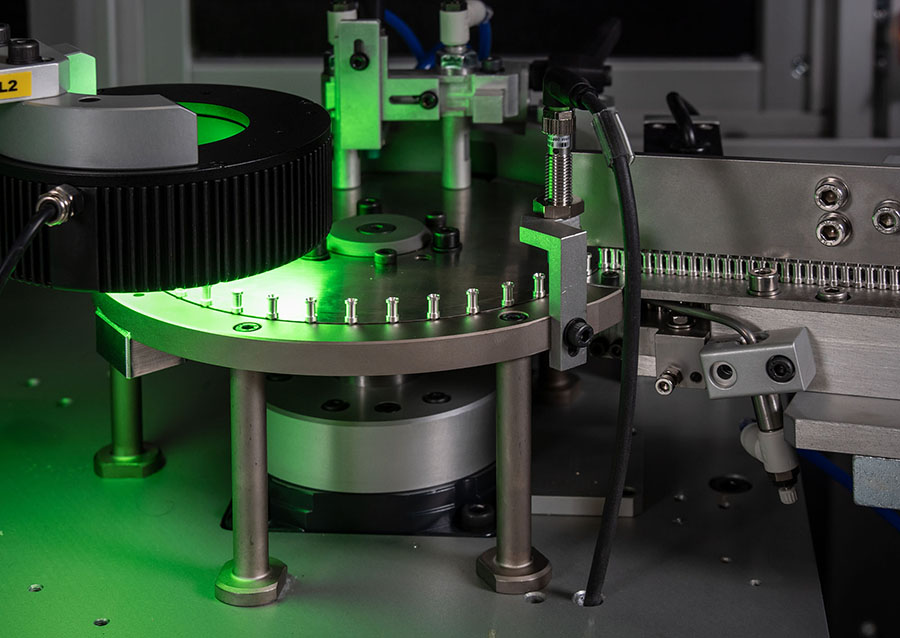
Improvements in performance and efficiency – in terms of both energy consumption (including compressed air) and effective productivity – optimize all operating phases: start-up, jam management, pauses, restarts, and end-of-batch operations.
This makes it possible to apply mass sorting even to lower-value products, increasing the overall competitiveness of the finished fastener.
Artificial Intelligence at the core of inspection
Within this framework, Artificial Intelligence plays a leading role.
The new vision software MCVx3, the first with native AI integration, enables the management of AI within traditional measurement tools. In practical terms:
- The same image can be analyzed simultaneously using traditional algorithms and AI tools
- Multiple AI sessions can coexist on the same machine to detect different defect types
- Trained neural networks can be easily reused across different recipes
- The entire AI inspection process is continuously monitored, allowing potential improvements
The result is an ability to detect defects that were previously identifiable only by the human eye.
From data to Zero Defect
Mcv ZED machines integrate systems for sharing and analyzing data, including the creation of data lakes for the development of dashboards and easy integration with other data sources. This approach enables users to trace defect origins, monitor the effectiveness of corrective actions and close the loop of continuous improvement.
With mcv ZED Dimac is not merely introducing new machines, but a vision of quality control, where technology, data and artificial intelligence converge toward a single goal: the Zero-Defect factory.
Join Us!
Book your live demo
Visit us @Wire 2026
Hall 16 Booth E13