Crack detection on fasteners is crucial for ensuring safety and reliability in many applications. Various technologies exist for this purpose, each with its own strengths and limitations. The most widespread solution consists of using a NDT (Non-Destructive Testing) station with eddy currents.
To date, this technology remains very valid and in fact, it is still widely used in sorting machines; however, new artificial intelligence tools combined with special cameras can recognize the presence of cracks in particular conditions, which the NDT system alone is not able to detect. The better solution must be evaluated based on the production control needs (material and shape of the parts, control speed, etc.).
Below is a comprehensive comparison of different approaches to crack detection.
NDT Eddy Current Inspection
How It Works
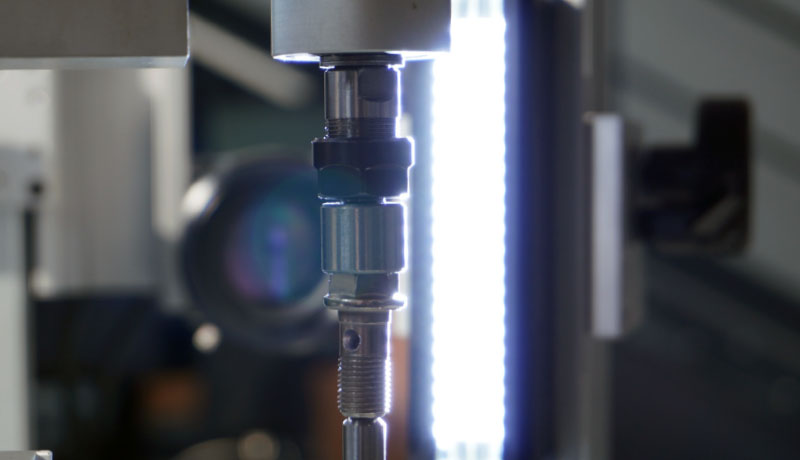
An eddy current probe generates an electromagnetic field that induces eddy currents in conductive materials. Any discontinuity (like a crack) produces an anomaly in the eddy currents, and is detectable as an electrical signal by a specific receiver probe.
Advantages
This control station can detect both open (surface) and closed (subsurface) cracks, as when they are under the material skin and so invisible to every optical method.
Limitations
Material Dependency: Ineffective on non-magnetic metals (e.g., aluminum, copper, brass)
Position Sensitivity: Effectiveness can vary based on crack location
Speed Limitations: Requires rotation of parts, which can slow down the inspection
Cost: The machinery can be expensive to implement and maintain
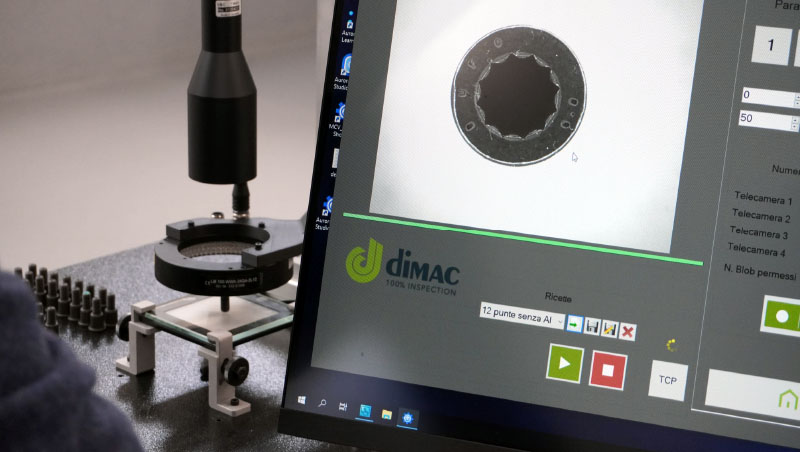
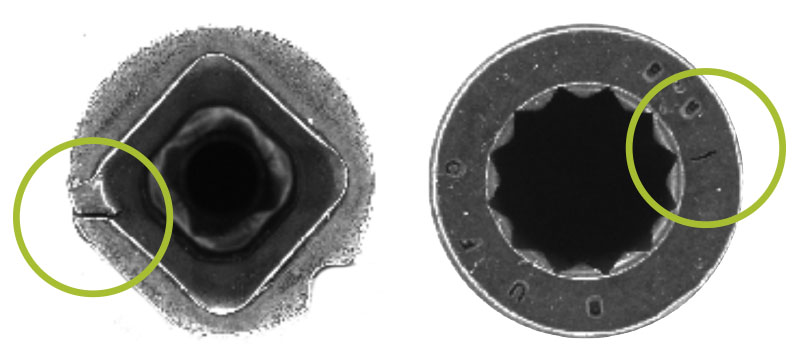
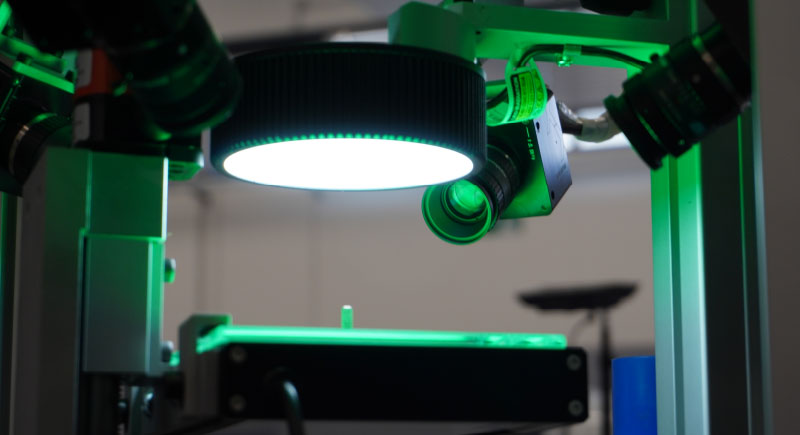
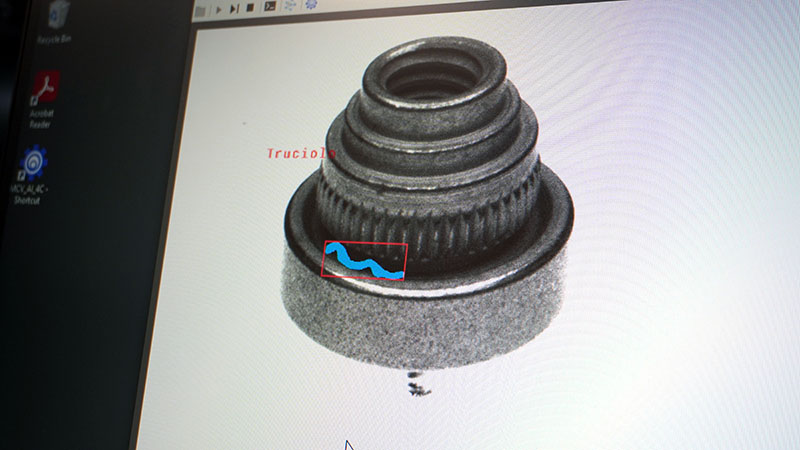
The Top HD Camera control station is equipped with high-definition cameras to capture grayscale images of fasteners. AI algorithms analyze these images to identify defects, including cracks that might not be visible to the naked eye or detectable by eddy currents.
Advantages
Able to detect small cracks on the upper or internal surfaces of the piece (impossible positions for eddy current)
Not affected by variations in lighting and surface refraction, ensuring better performance than traditional optical control
Capable of distinguishing between cracks and other markings
This process requires considerable computation time for AI training and validation phases. The AI training process requires a robust computing station, the necessary software licenses, and specific skills.
The sorting machine software includes an easy procedure to assist operators in acquiring sets of images of compliant and defective samples. From these sets, Dimac’s technicians build an effective and computationally efficient neural network.
The trained neural network (in practice a file) is upload by remote on the sorting machine, to be used for sorting.
Conclusion
The landscape of crack detection in fasteners is evolving, driven by advancements in AI and imaging technologies.
While traditional methods like eddy current remain effective, newer approaches AI-based and optical systems offer significant advantages in speed, flexibility, and defect detection capabilities.
AI enhances the efficiency and precision of inspections, enabling the identification of patterns and defects beyond human capabilities.
Continuous refinement of AI models and datasets is essential for maintaining effectiveness and accuracy, and human expertise is once again crucial for interpreting results and making informed decisions.